
Foreign investors purchased just $4.6 billion of Canadian securities in March, the lowest monthly investment since the beginning of 2026, according to new data released May 15 by Statistics Canada. Canadian investors, meanwhile, acquired $3.9 billion of foreign securities, well below the monthly average investment of $16.7 billion during the previous four months. The combined activity generated a net inflow of just $719 million into the Canadian economy in March, marking a dramatic slowdown from the $36 billion net inflow seen in January.
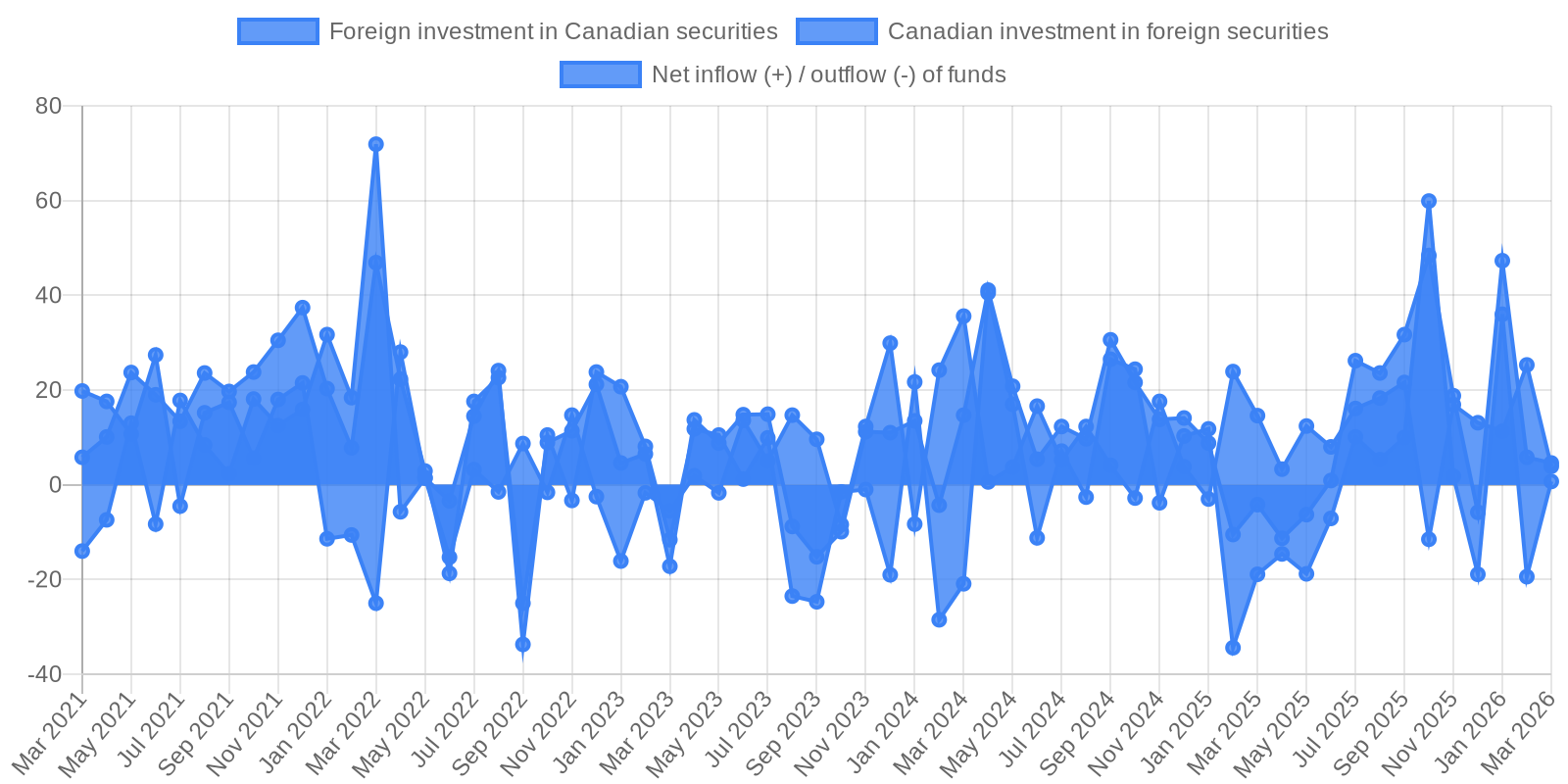
Canada's international transactions in securities from March 2021 to March 2026 show foreign investment in Canadian securities dropped to $4.6 billion in March 2026, while Canadian investment in foreign securities fell to $3.9 billion, producing a net inflow of just $0.7 billion.
The March figures brought foreign investment in Canadian securities to $57.8 billion for the first quarter of 2026. In March specifically, foreign acquisitions of debt securities totalled $8.5 billion, driven largely by provincial government bonds denominated in euro. But this was offset by a $3.8 billion divestment in Canadian shares, following a $9.1 billion divestment in February. Non-resident investors reduced their exposure to corporate bonds by $1.7 billion, largely reflecting retirements of covered bonds, and cut their holdings of federal government bonds by $1.2 billion after five consecutive months of investment totalling $54.9 billion. The share divestment was led by the banking sector at -$7.5 billion and energy and mining at -$6.0 billion, and was attributed to retirements of Canadian shares resulting from cross-border merger and acquisition activities. Canadian share prices, as measured by the Standard & Poor's/Toronto Stock Exchange composite index, decreased by 4.6% in March.
On the outbound side, Canadian investment in US corporate bonds reached a record high for a second consecutive month, with purchases totalling $10.4 billion in March following a $4.8 billion investment in February. Nearly half of March's acquisitions were in bonds denominated in Canadian dollars. This surge in corporate bond buying was moderated by Canadian investors reducing their holdings of US government bonds by $7.8 billion and foreign money market instruments by $2.4 billion. Canadian investors also acquired $1.9 billion of foreign equity securities in March, considerably down from the $32.7 billion investment in February. They added $2.7 billion of US shares in March, bringing the first quarter investment to an unprecedented $40.3 billion, with activity largely targeting US large capitalization technology shares.
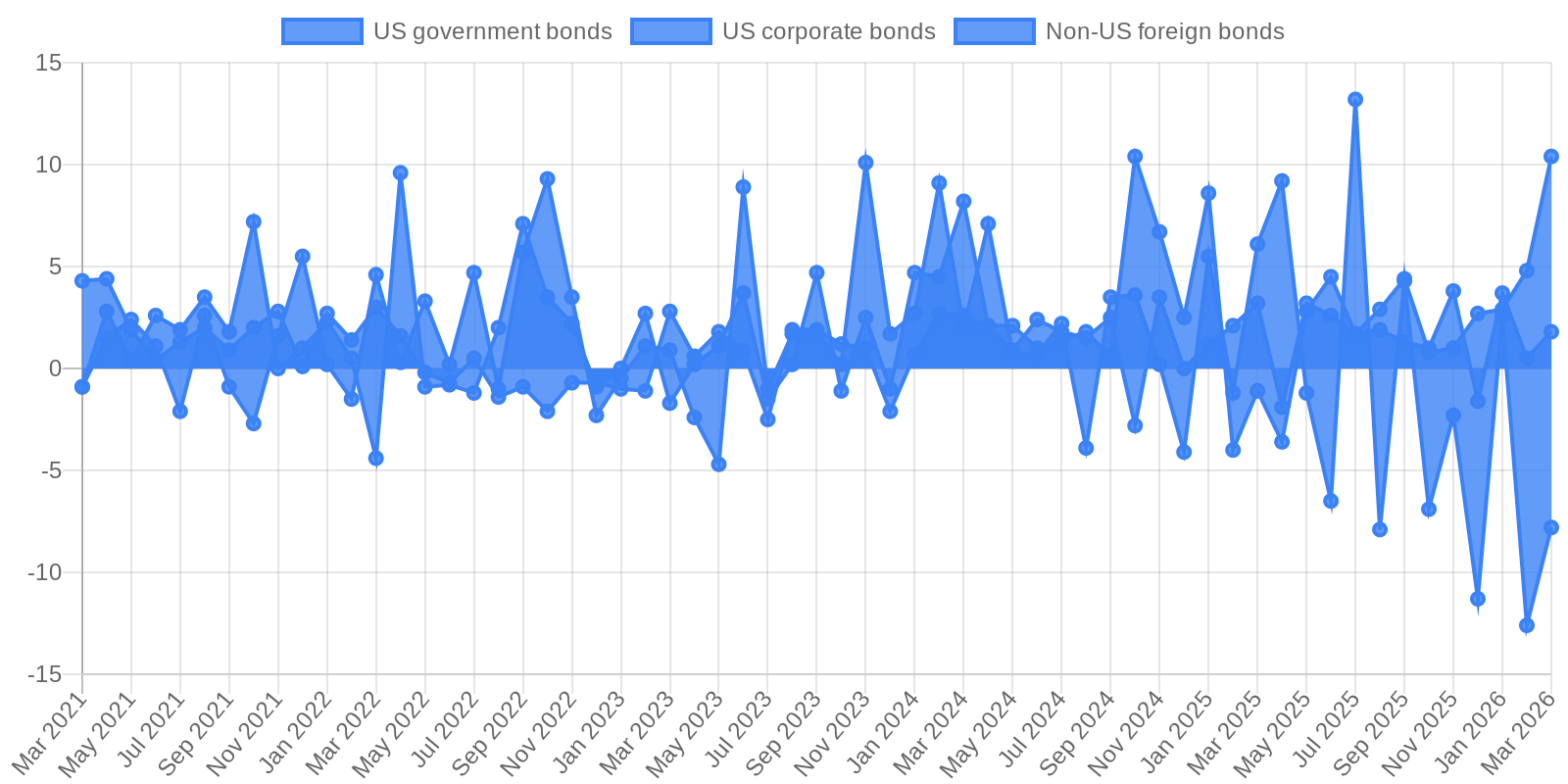
Canadian investment in foreign bonds from March 2021 to March 2026 reveals record purchases of US corporate bonds reaching $10.4 billion in March 2026, while holdings of US government bonds fell by $7.8 billion.
The report highlights that activity in federal government and corporate debt securities was marginal in March, as investment in money market instruments offset divestment in bonds. The shift away from federal government bonds marks a notable reversal after the strong five-month run that preceded it. Statistics Canada notes that both US long- and short-term interest rates were up in March, providing context for the pullback in US government debt holdings. The agency emphasizes that the divestment in Canadian shares was attributable to retirements resulting from cross-border merger and acquisition activities rather than simple selling pressure, suggesting structural factors rather than market sentiment drove the outflows.
The March slowdown reflects a combination of forces reshaping cross-border capital flows. The sharp decline in Canadian equity attractiveness—with foreign investors pulling back from banking and energy stocks amid M&A activity—coincided with a domestic stock market decline of nearly 5%. At the same time, Canadian investors' record appetite for US corporate bonds, particularly Canadian-dollar denominated issues, suggests they're seeking higher yields or diversification outside domestic markets. The near-zero net inflow of $719 million represents a stark contrast to the volatile but generally positive flows seen through most of 2024 and early 2026, when January alone brought $36 billion into Canada. The report's data shows cross-border securities transactions have become increasingly unpredictable, swinging from massive inflows to outflows month by month, making it harder for policymakers to gauge sustained capital flow trends. With Canadian investors pouring unprecedented sums into US technology stocks—$40.3 billion in just the first quarter—the data suggests a growing preference for American equities even as foreign interest in Canadian stocks weakens.