
Canada added just 14,000 jobs in March 2026, a meager rebound after losing nearly 110,000 positions in January and February combined. The unemployment rate held steady at 6.7 per cent, but economists aren't celebrating. "The labour market seems to be frozen," says Dominique Lapointe, director of macro strategy at Manulife Investment Management. While the numbers stopped the bleeding, they did nothing to reverse what one analyst called a "bloodbath" for Canadian workers. The modest March gain masks deeper trouble: manufacturing shed 28,000 workers in January, and the sector has been hemorrhaging positions for over a year.
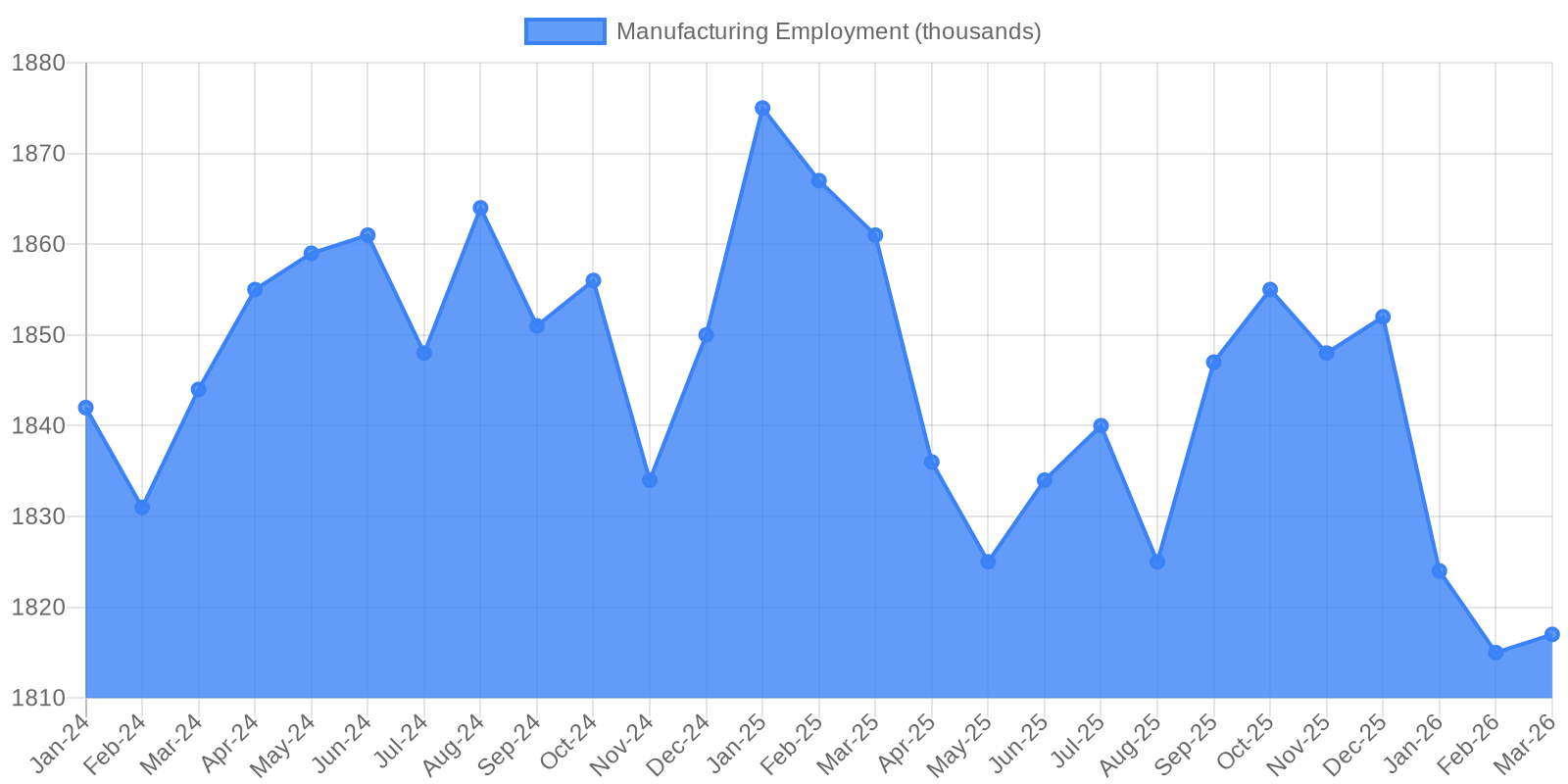
Manufacturing employment in Canada has declined steadily from its January 2025 peak of 1,875,000 workers to 1,817,000 by March 2026, representing a loss of 58,000 positions over 14 months.
The control article reveals just how badly manufacturing has been hit. Roughly 37,000 manufacturing jobs were lost in 2025, driven by U.S. tariffs hitting the manufacturing, warehousing and auto sectors, with companies cutting production plans and embarking on layoffs. Ontario bore the brunt, with a decline of 45,000 jobs or 0.6 per cent in 2025. The public sector is now the only thing keeping the hiring market afloat, according to the BNN Bloomberg analysis. Healthcare, education, and public administration showed strength, while private sector jobs in retail, wholesale, and manufacturing continue to slide. This isn't a diversified recovery—it's government spending propping up employment numbers while the productive economy struggles.

Employment changes across Canadian industries from February to March 2026 show manufacturing gained only 2,500 jobs, while finance, accommodation, and retail sectors continued shedding positions. Other services and professional services led modest gains.
The charts tell the story clearly. Manufacturing employment peaked at 1,875,000 workers in January 2025, then dropped to 1,817,000 by March 2026—a loss of 58,000 positions in just over a year. That's a 3.1 per cent decline in a sector that employed nearly two million Canadians. The month-to-month data from February to March 2026 shows manufacturing barely gained 2,500 jobs, ranking eighth among all industries. Meanwhile, finance and real estate lost 11,200 positions, accommodation and food services shed 10,000 jobs, and wholesale and retail trade dropped 6,700 workers. The pattern is unmistakable: private sector jobs that depend on consumer spending and business investment are disappearing, while government-funded positions are growing. Payroll employment in the Canadian manufacturing sector stood at just over 1.5 million people in December 2025, down 40,600 from December 2024, as the sector faced tariffs on some exports to the United States and amid a broader slowdown.
Manufacturing remains a foundational pillar of any nation's economy and cannot be overlooked. In Canada, the sector has been significantly weakened, largely due to government policies that have failed to shield domestic producers from trade headwinds and mounting cost pressures. The decline of manufacturing extends beyond factory jobs, disrupting employment across the broader supply chain, including both upstream suppliers and downstream industries. When a car plant closes or reduces shifts, it doesn't just affect assembly line workers—it ripples through parts manufacturers, logistics companies, dealerships, and service providers. Canada's labour market won't truly recover until the private sector, particularly manufacturing, finds its footing again.