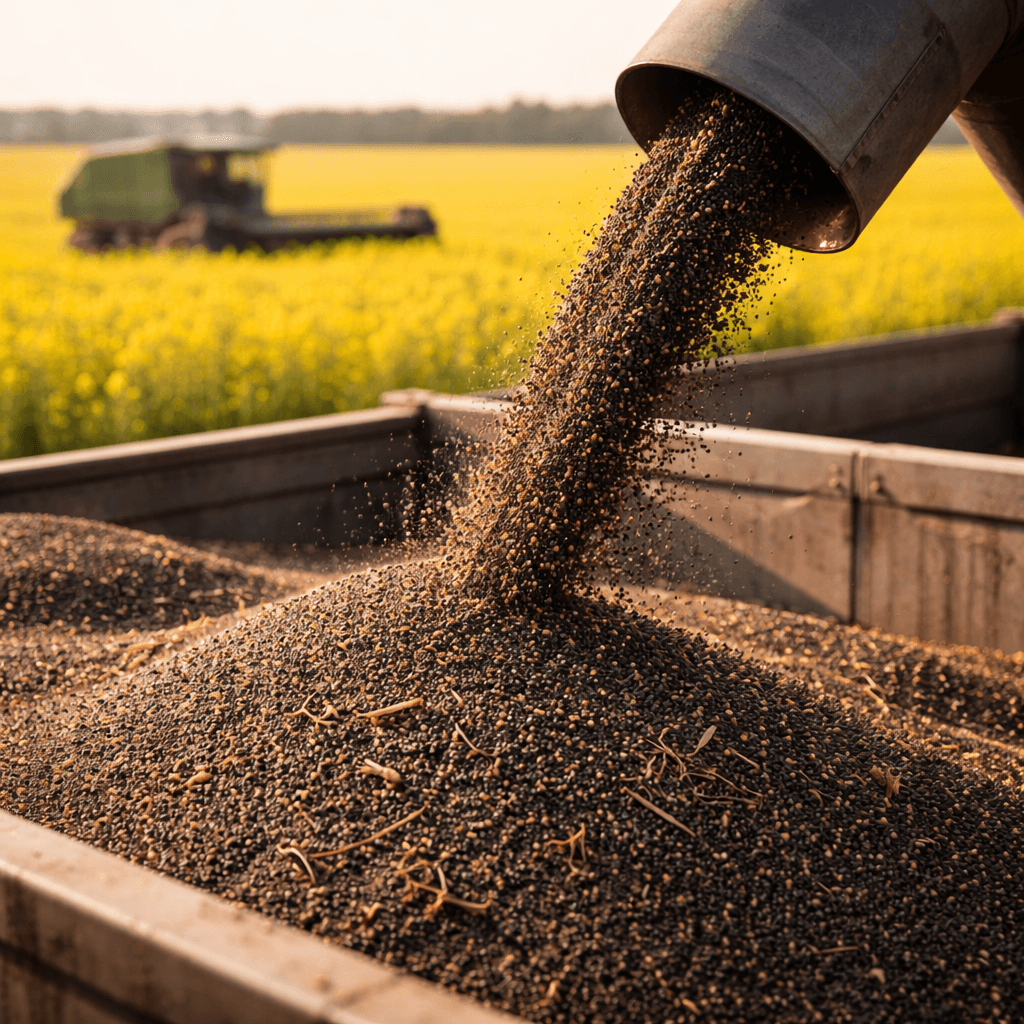
Canadian canola seed exports to China—worth roughly $5 billion annually—face a punishing 75.8 percent tariff imposed by Beijing, according to Statistics Canada trade data highlighted in an April 29, 2026 analysis published in The Hub. The figures underscore what Hub contributor Ed Fast described as a critical backdrop to China's ongoing bid to join the Comprehensive and Progressive Agreement for Trans-Pacific Partnership, a trade pact built on principles of market-based competition and adherence to trade commitments. Fast argued that China's application represents a direct challenge to the agreement's foundational rules, given Beijing's long history of flouting trade obligations.
The 75.8 percent tariff on Canadian canola seed was imposed by Beijing in 2025 as what analysts characterized as strategic leverage ahead of Canada's review of its 100 percent tariff on Chinese-made electric vehicles. The tariffs expanded beyond canola to hit Canadian seafood and pork exports, representing what the report called a broad assault on agricultural sectors worth billions of dollars. Despite the United States leading the charge on EV tariffs with 100 percent duties imposed in May 2024, China chose to focus its retaliation primarily on Canada rather than the U.S. The pattern of targeting Canada specifically echoes Beijing's response to the 2018-2019 Huawei executive extradition dispute, when China imposed canola tariffs and detained two Canadian citizens.
"When trading partners have pushed back on specific abuses, China has deployed economic coercion," Fast wrote, describing tactics that include cutting off exports of critical raw materials, imposing punishing tariffs, and leveraging market access as a geopolitical weapon. Bill Hawkins, head of trade and investment at Sussex Strategy Group and former chief of staff to Canada's minister of international trade, described China's approach as deliberate economic coercion. "They basically put in place tariffs that will kill our trade into that country, and they've indicated they could remove them at any time," Hawkins observed. Fast contended that "This is the country now seeking to join a trade agreement built on enforceable rules," noting China's retaliatory suspension of Canadian canola imports in 2019 was "a textbook example of trade as a cudgel rather than commerce."
Fast's analysis traced China's pattern of undermining trade commitments back more than two decades, arguing that Beijing has spent that time flouting WTO obligations through state-owned enterprises deployed as instruments of industrial policy, flooding global markets with artificially subsidized goods across sectors including steel, aluminum, solar panels, and electric vehicles. The report noted that Beijing has also erected non-tariff barriers—regulatory harassment, discriminatory licensing regimes, and arbitrary customs delays—that effectively nullify market-access commitments made under WTO agreements. Canada's EV tariff decision was itself part of coordinated G7 efforts to counter Chinese subsidization and oversupply strategies in strategic industries, yet Ottawa bore the brunt of Beijing's retaliation while the United States faced comparatively little pushback.
The CPTPP, originally negotiated as the Trans-Pacific Partnership, was built around a coalition of nations sharing commitments to the rule of law, market-based competition, and transparent regulatory processes. Fast contended that negotiations were deliberately painstaking because member nations sought to maximize the benefits of comparative advantage among countries that would actually honour their commitments, with like-minded partners sharing a dedication to transparency and meaningful enforcement mechanisms. Ottawa should oppose China's accession to the CPTPP until Beijing demonstrates sustained, verifiable compliance with existing multilateral trade obligations, he argued—a stance grounded in what he characterized as China's demonstrated willingness to weaponize trade relationships when geopolitical interests clash with commercial ones.