
Just over half of Canadian business leaders—51 per cent—expect the federal government's economic measures will leave their business "much better off" or "somewhat better off" over the next three years, according to KPMG's National Business and Trade Outlook survey released August 5, 2026. The survey of 359 business leaders and decision-makers reveals cautious optimism tempered by a strong appetite for faster execution, with more than half (55 per cent) believing the government is making progress in strengthening support for Canadian businesses. However, as U.S. trade tensions re-ignite, companies are taking concrete steps to adapt: two-thirds have raised prices and one in three are eyeing new export markets.
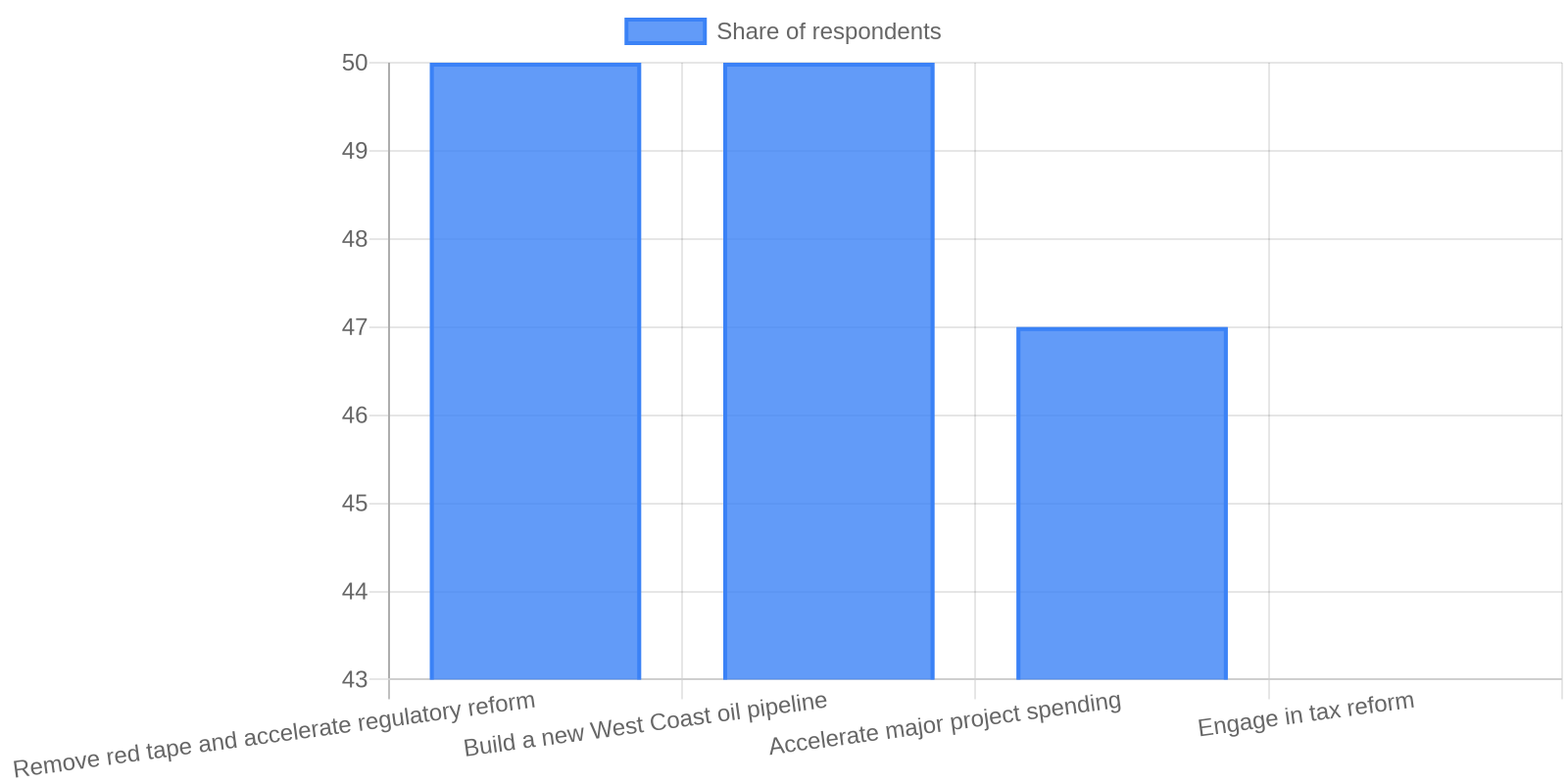
Business priorities for strengthening the Canadian economy, led by regulatory reform and pipeline infrastructure at 50% each. Source: KPMG National Business and Trade Outlook Survey, 2026.
The survey breaks down business sentiment into granular detail: 14 per cent of leaders expect to be "much better off" from federal measures, while 36 per cent anticipate being "somewhat better off." Thirty-one per cent say there will be "no material impact," and 15 per cent expect to be "somewhat worse off" or "worse off." When asked to rank their priorities for boosting the Canadian economy, half of respondents identified removing red tape and accelerating regulatory reform as essential, tied with building a new West Coast oil pipeline at 50 per cent each. Accelerating major infrastructure project spending followed at 47 per cent, with tax reform—including corporate taxes and investment incentives—at 43 per cent. On trade diversification, one-third (33 per cent) of businesses plan to expand to new markets within the next one to three years, while 26 per cent are already exploring exports to markets where Canada has a trade deal. The European Union led non-U.S. destinations, with 26 per cent of businesses reporting increased exports there over the past year and 25 per cent planning growth there in the next one to three years. The United Kingdom came second (24 per cent past year, 19 per cent planned), followed by Mexico (18 per cent past year, 16 per cent planned). Australia and New Zealand registered 14 per cent past-year growth with 15 per cent planning expansion, while China saw 13 per cent past-year exports and 14 per cent planned growth.
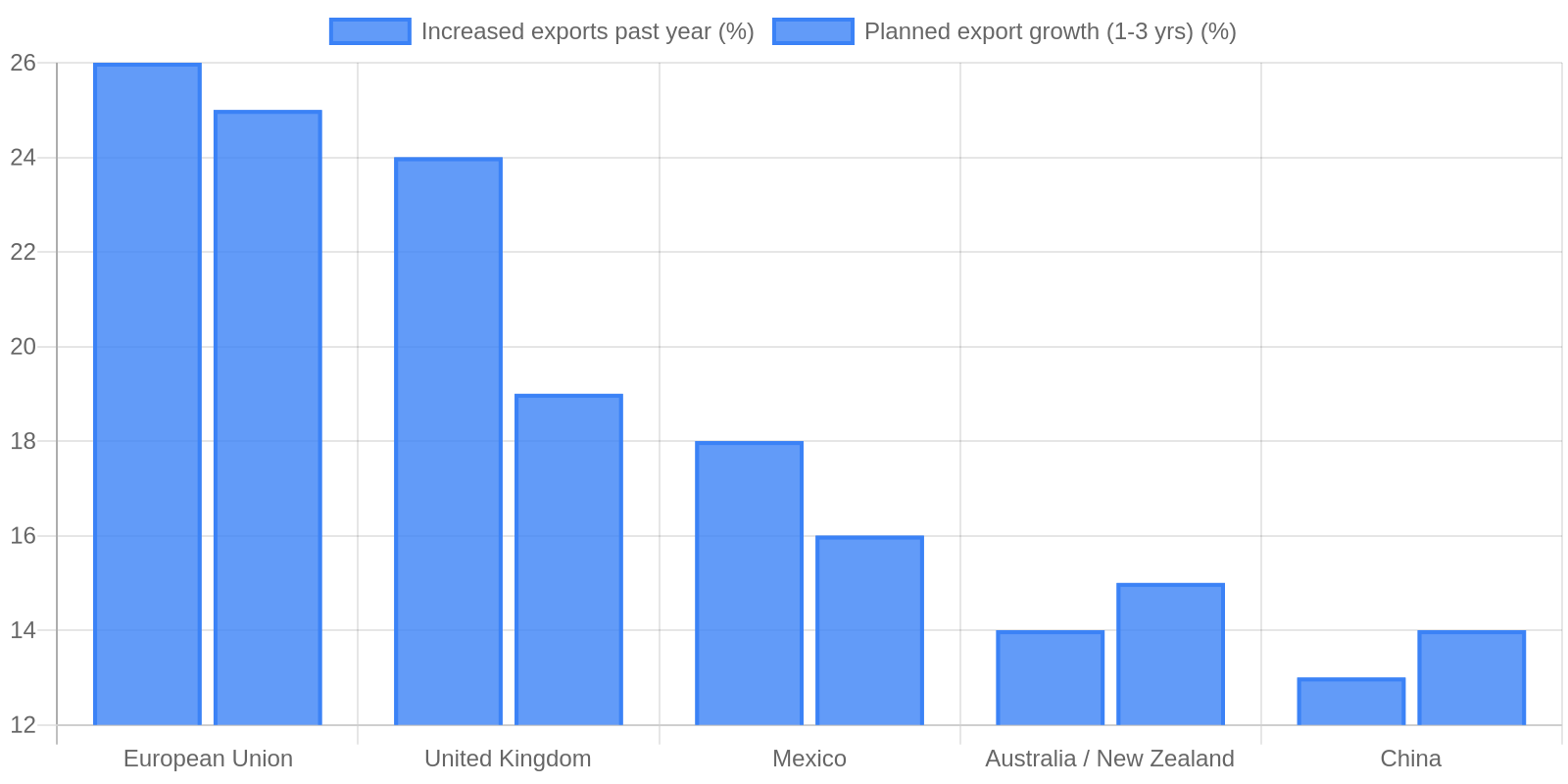
Non-U.S. export markets for Canadian businesses, showing past-year performance and future growth plans. The EU, UK, and Mexico lead diversification efforts. Source: KPMG National Business and Trade Outlook Survey, 2026.
Tariff pressures are reshaping pricing strategies across Canadian businesses, the report finds. Two-thirds (66 per cent) have adjusted prices to account for some or all tariff costs: 35 per cent have adjusted for some but not all costs, while 31 per cent have accounted for full tariff costs. Only 39 per cent report no price changes resulting from tariff-related pressures. On regulatory burden, more than two-thirds (67 per cent) agree that regulatory compliance requirements at all levels of government—including red tape and consensus-based decision-making—have created "institutional gridlock, delaying projects and deterring investment." About the same proportion (65 per cent) say over-regulation and higher taxes make it harder for businesses to scale and remain in Canada. On the diplomatic front, nearly seven in ten (69 per cent) agree Canada should be tough negotiators and use all points of leverage in CUSMA negotiations, while 65 per cent agree Canada should be "more transactional and dispassionate when negotiating with the U.S., as this is the new normal."
"Business leaders want governments to stay focused on the actions that are within Canada's control to build economic resilience," says Lachlan Wolfers, National Leader at KPMG Law. "They want government to work with them to quickly deliver on the federal economic agenda, improve tax competitiveness, reduce red tape and diversify trade." The report notes that while optimism exists, it's tempered by a desire for faster execution. Joy Nott, Partner in Trade and Customs at KPMG, explains that business leaders "want Canada to continue to defend its position at the CUSMA negotiating table and reduce tariff exposure," but there's also "a recognition of a fundamental reset in the trade relationship and the risks that entails." Despite ongoing challenges, nearly half (47 per cent) of leaders are confident in their firm's ability to increase investment in Canada if supported with "Buy Canadian" procurement, government incentives and new financing.
The report's findings reveal a business community caught between two realities: the gravitational pull of the U.S. market and the strategic imperative to diversify. According to Ali Jaffery, Partner and Chief Economist at KPMG Canada, "Canadian businesses are taking trade diversification seriously, and official data indicate that shift is already underway, driven by demand for commodities." However, he emphasizes that "the U.S. still accounts for the bulk of trade in both goods and services," describing the dynamic as "diversification, not decoupling." The regulatory frustration businesses express doesn't mean they reject oversight entirely—just over half (51 per cent) agree that regulatory compliance is an important trade-off to protect health, safety, the environment and the duty to consult with Indigenous Peoples. What they want, the report indicates, are "faster, more predictable processes that accelerate project delivery and enable investment and scaling decisions." The survey was conducted June 25 to July 13, 2026, shortly before the latest U.S. threat to impose a 50 per cent tariff on certain Canadian exports and a new 10 per cent "forced labour" tariff, meaning the sentiment captured reflects an already volatile period—one that has likely only intensified since.
The path forward hinges on execution speed, the report concludes. Wolfers notes that "Canada has the right foundations for success in attracting global investment dollars, but now it needs the right policy setting to make this known to the world." The survey reveals that 72 per cent of respondents identify as exporters, with 79 per cent saying their goods and services are compliant under CUSMA, suggesting a business community already deeply integrated into North American and global trade networks. With two-thirds of businesses having already adjusted their pricing strategies and one-third actively pursuing market diversification, Canadian companies aren't waiting for perfect conditions—they're adapting in real time. The question now is whether government can match that pace and turn economic promises into the regulatory relief, infrastructure investment and trade support that businesses say they need to compete.