
Canada's economy added 14,000 jobs in March, edging up just 0.1% after shedding more than 100,000 positions in January and February combined. The unemployment rate held steady at 6.7%, offering relief to policymakers but little comfort to job seekers navigating a sluggish market. Marc Desormeaux, vice-president of policy and economist at the Business Council of Canada, said "the bleeding stopped after two consecutive monthly employment declines, but March's data continue the trend of soft labour market performance". The modest gains came as British Columbia's unemployment rate hit its highest level in a decade, outside the COVID-19 pandemic, reflecting regional pressures from U.S. tariffs and broader economic uncertainty.
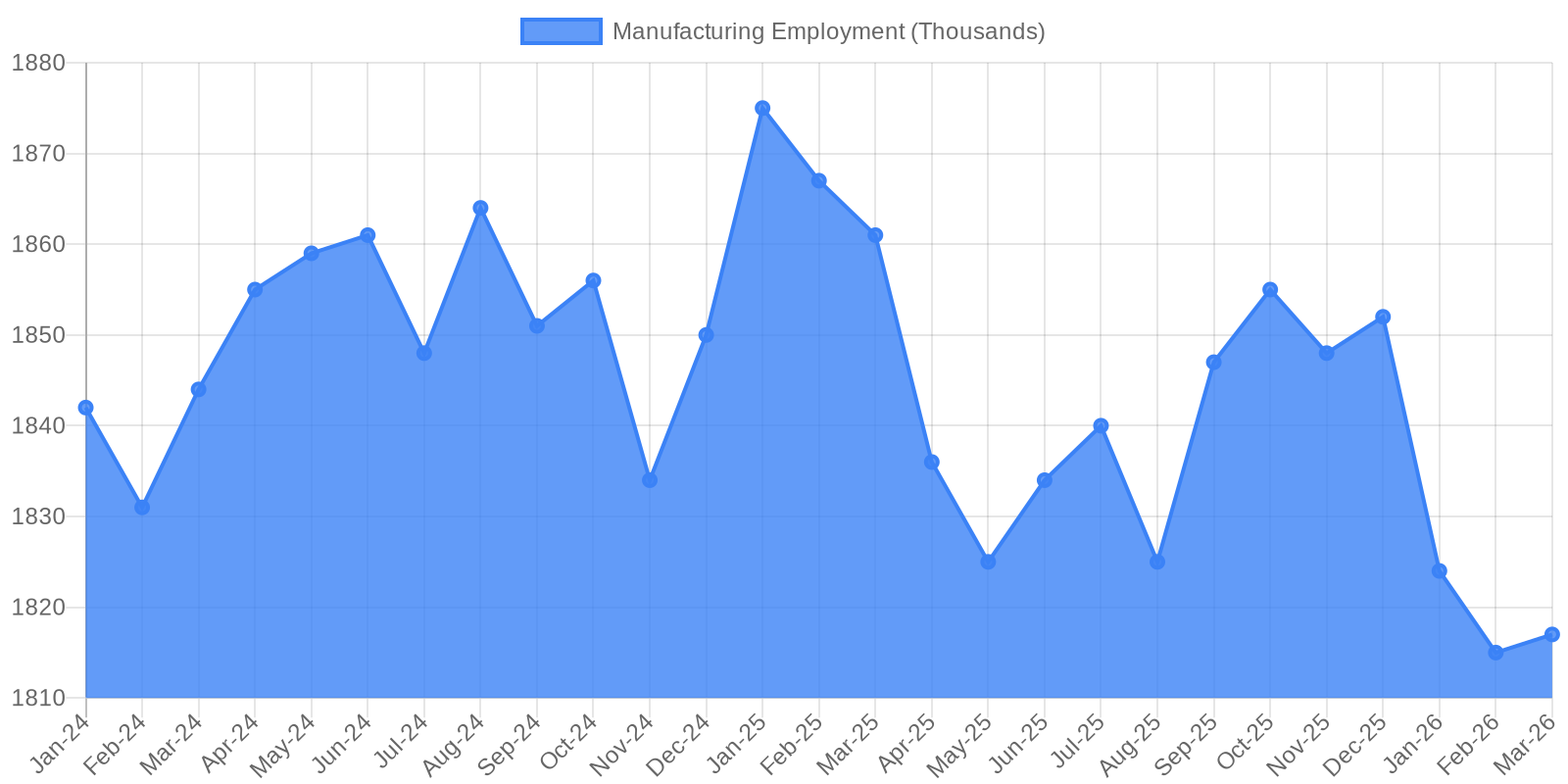
Canadian manufacturing employment has declined from a peak of 1.875 million workers in January 2025 to 1.817 million in March 2026, a loss of 58,000 jobs despite government industrial policy interventions.
The employment picture looks especially grim when you zoom in on manufacturing, where government industrial policy has failed to deliver. The sector has become a cautionary tale about the limits of top-down economic planning. While politicians have poured billions into favoured industries through subsidies and tax breaks, the chart tells a different story: Canadian manufacturing employment peaked at 1,875,000 workers in January 2025 but has since dropped to 1,817,000 by March 2026—a loss of 58,000 jobs in just over a year. That's not a rounding error. That's a 3.1% decline happening while governments claim their interventions are "building back better." The Fraser Institute analysis argues this demonstrates the futility of trying to pick winners and losers in the economy, as market forces and policy missteps create outcomes politicians can't control.
Here's the thing about manufacturing declines: they don't happen in isolation. When a factory cuts shifts or closes its doors, the ripple effects spread far beyond those assembly line workers who lose their paychecks. The truck drivers who delivered raw materials see fewer routes. The maintenance contractors who serviced equipment get fewer calls. The restaurants near the plant lose lunch crowds. The chart shows manufacturing jobs fell from 1,861,000 in March 2024 to 1,817,000 in March 2026—a net loss of 44,000 positions over two years, even as Canada's population grew by over a million people. The high unemployment rate is "mostly driven by slower hiring, rather than by increased layoffs," suggesting companies aren't confident enough to expand. That fits what we're seeing across the economy: businesses sitting on their hands, waiting to see if trade tensions ease, if interest rates shift, or if consumer spending picks up.
Manufacturing remains a foundational pillar of any nation's economy and can't be overlooked—it creates middle-class jobs, drives innovation, and supports entire supply chains. In Canada, the sector has been significantly weakened, largely due to government policies that layer on regulatory costs, carbon pricing, and tax structures that make it harder to compete with American and Mexican factories. The decline of manufacturing extends beyond factory jobs, disrupting employment across the broader supply chain, including both upstream suppliers who provide materials and downstream industries that depend on manufactured goods. When you lose 58,000 manufacturing jobs in a year, you're not just losing 58,000 workers—you're losing the machinists, the logistics coordinators, the quality control inspectors, and all the supporting roles that make modern production possible.