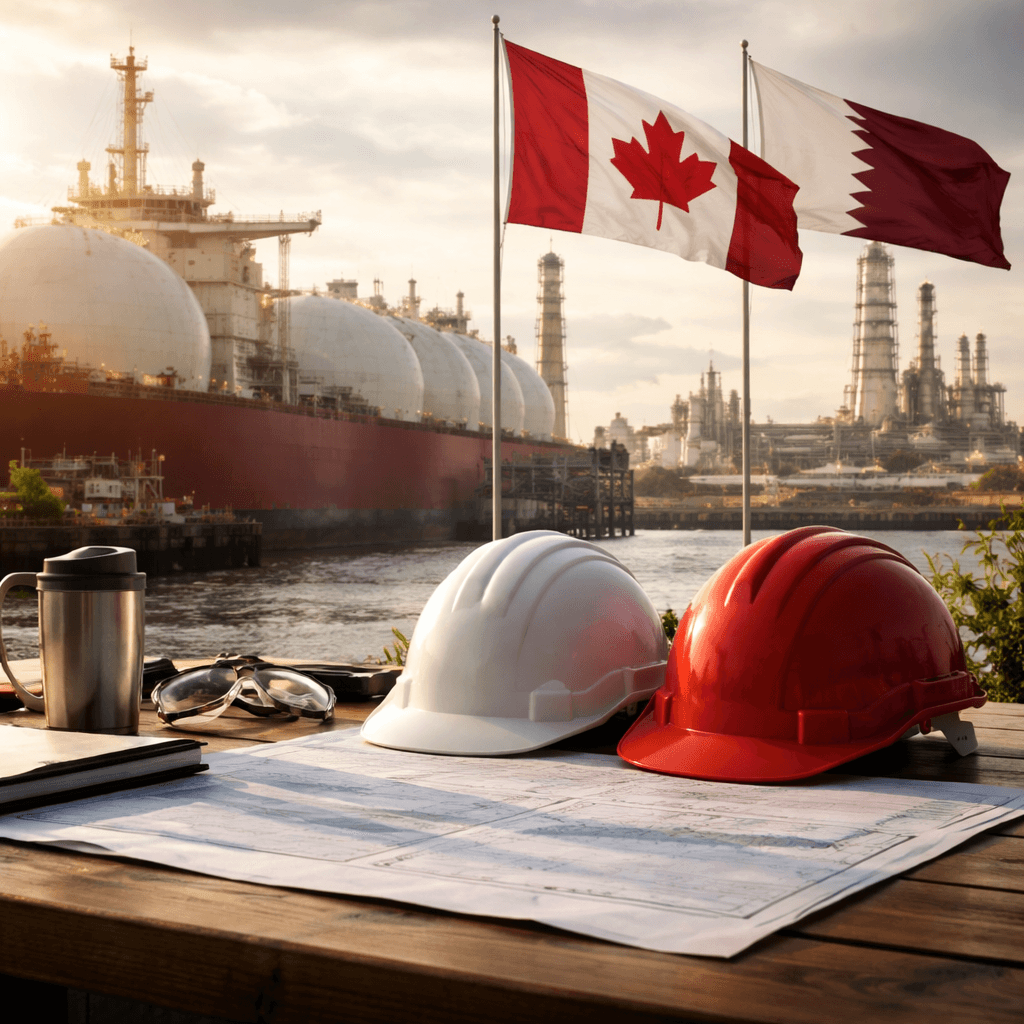
An Iranian drone attack on Qatar's Ras Laffan facility damaged two of the country's 14 LNG production trains, taking 12.8 million tonnes of annual capacity offline for three to five years. The Ras Laffan plant covers about a fifth of global liquefied natural gas supply, and QatarEnergy has declared force majeure on some long-term LNG supply contracts, including for customers in Italy, Belgium, South Korea and China. The Financial Post reports that this disruption could accelerate Canadian LNG projects as global buyers scramble to secure alternative supplies. European gas prices surged as much as 54% following the attack, highlighting just how dependent the world remains on a handful of LNG producers.
The timing couldn't be better for Canada to step up. A May 2025 Fraser Institute study found that if Canada were to double its current natural gas production and export the additional supply to Asia as LNG to displace coal, global greenhouse gas emissions could be reduced by up to 630 million tonnes annually—equivalent to 89% of Canada's total emissions. That's not just an economic opportunity, it's a climate win. Canada enjoys several competitive advantages, including cooler temperatures that reduce liquefaction energy costs and a strategic location that offers shorter shipping routes to Europe and Asia compared to many other suppliers. LNG shipments from Canada's West Coast to Asia take roughly 10 days, compared to shipments from the US Gulf Coast, which take about 20 days. With Qatar's infrastructure damaged and repair timelines stretching years, countries that once relied on Qatari gas are hunting for stable, long-term alternatives.
But Canada can't just flip a switch. Despite having massive resources, Canada has yet to diversify its natural-gas export market and relies entirely on the United States—in 2023, Canada exported approximately 84 billion cubic meters of natural gas, all of which was sent to US regions via 39 pipelines, leaving Canadian producers vulnerable to US policy changes. The C.D. Howe Institute framework for prioritizing major projects emphasizes that Canada needs infrastructure connecting resources to global markets. LNG Canada in Kitimat started shipping its first cargoes in 2025, but that's just one facility. Regulatory challenges and a mix of federal and provincial policies have slowed or blocked LNG developments in Canada. The Fraser Institute study points out that years of regulatory delays and uncertainty have left billions in potential revenue on the table while other countries seized market share.
Qatar's crisis is a wake-up call for energy-importing nations: putting too many eggs in one basket is risky, especially when that basket sits in a geopolitically volatile region. Canada has the natural gas reserves, the technical expertise, and the geographic advantage to become a major LNG exporter. What it needs now is regulatory clarity and the political will to build the infrastructure that connects Canadian gas to global markets. Countries looking to diversify away from Middle Eastern supplies won't wait forever—if Canada doesn't move quickly, they'll turn to the United States, Australia, or emerging African producers instead. The opportunity is here, but the window is closing.