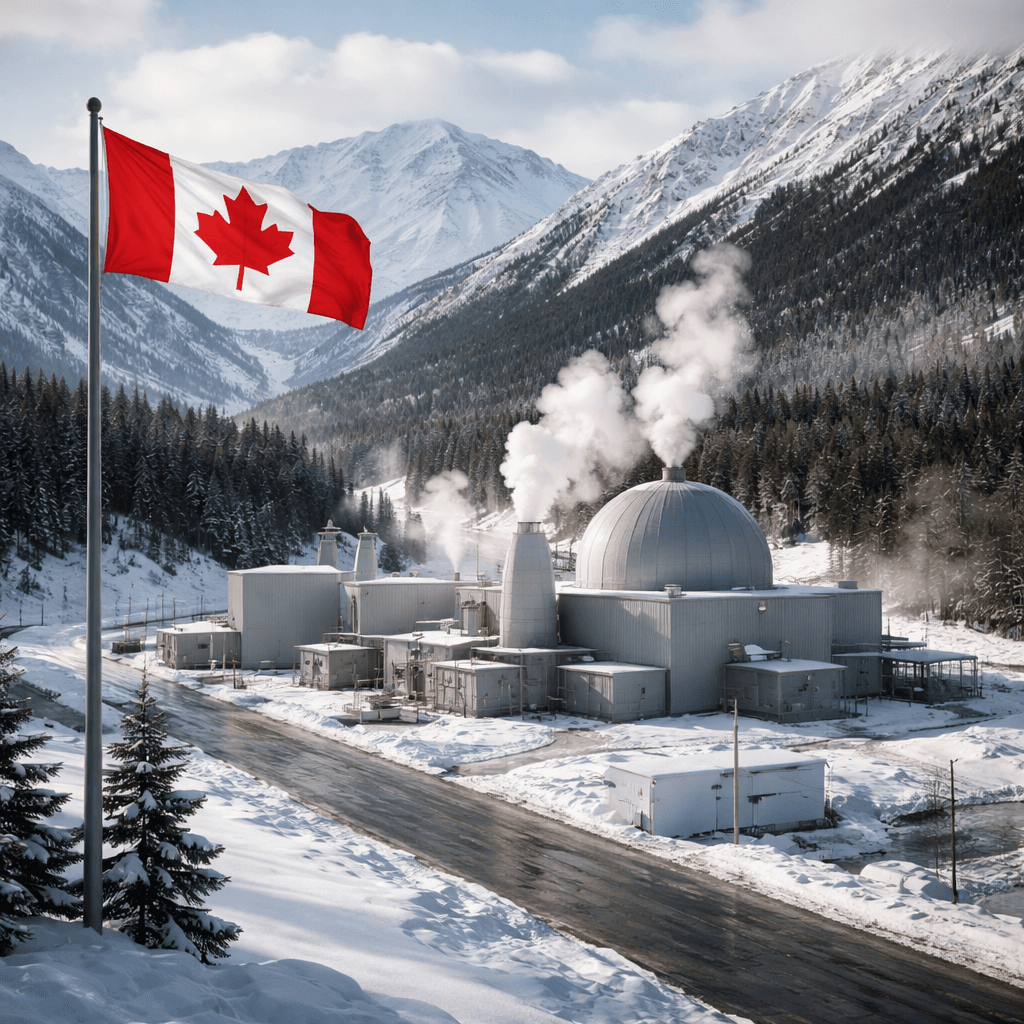
The Canadian government announced a transformative new Nuclear Energy Strategy set for release by the end of 2026, alongside an initial $40-million investment to assess Canadian-controlled microreactors for remote military and northern facilities. Minister of Energy and Natural Resources Tim Hodgson made the announcement today at the Canadian Nuclear Association Conference, framing the initiative as essential to Canada's economic security and energy sovereignty. The strategy aims to position Canada as a global nuclear leader while expanding domestic electricity grids and creating thousands of jobs.
Nuclear power currently generates about 13 percent of Canada's electricity from 17 CANDU reactors in Ontario and New Brunswick. The nuclear energy sector adds $22 billion annually to the Canadian economy, while Canada produced roughly 24 percent of total global uranium output in 2024 as the world's second-largest producer. About 90 percent of Canada's uranium is exported to other countries for peaceful use as nuclear fuel. Saskatchewan's uranium mining and milling contributed approximately $2.6 billion to Canada's economy in 2024 while directly employing over 3,400 Canadians—nearly half of whom are workers and residents in Saskatchewan's north. The federal government has also committed $2.2 billion over ten years in capital investments at the Chalk River Laboratories, Canada's national nuclear labs, including the new Advanced Materials Research Centre.
According to Minister Hodgson, "Canada has long been a nuclear leader—but we will not remain one by standing still." He emphasized that the government is "moving at speeds not seen in generations to get big things done." The new strategy will be structured around four pillars: Enabling New Builds Across Canada; Being a Global Supplier and Exporter of Choice; Expanding Uranium Production and Nuclear Fuel Opportunities; and Developing New Canadian Nuclear Innovations, including both fission and fusion. Minister of National Defence David J. McGuinty stated that the microreactor feasibility program is "an important step in supporting Canadian-controlled nuclear energy technology and enabling a sustained defence presence in the Arctic and the North."
The strategy builds on Canada's possession of the world's highest-grade uranium and decades of innovation in CANDU technology, positioning the country to capture opportunities in a global nuclear industry expected to grow by up to $200 billion per year by 2030. The government describes its focus as "growing Canadian industry in order to achieve energy affordability and security at home while seizing the global opportunity." The $40-million initial investment for 2026–2027, channeled through the Department of National Defence, will assess microreactor potential specifically for remote and northern DND and Canadian Armed Forces facilities, addressing energy security in regions where affordability and reliability remain fragile. Early investments in the microreactor feasibility program include $6 million in 2025–2026, with $4.7 million dedicated to research and development at Chalk River Laboratories.
The Chalk River capital investments will allow Atomic Energy of Canada Limited (AECL) to consolidate outdated facilities into a modern research complex supporting CANDU technology, nuclear safety and forensics, small modular reactors, reactor fuel development, and utility support for reactor life extension and reliability. Working in partnership with provinces, territories, utilities, industry, Indigenous partners and labour, the targeted agenda aims to expand Canada's grid, electrify the economy, create thousands of jobs, unlock trade diversification opportunities and secure domestic energy supplies. The government frames nuclear energy as central to delivering secure, affordable and clean electricity that powers long-term economic growth—a future where Canada doesn't just participate in the global nuclear industry, but leads it.